DSWD-NIA Livelihood Program Generates Over P 500,000 for Davao Farmers, Strengthens Climate-Resilient Agriculture

DAVAO CITY – Nearly 1,000 farmers in the Davao Region are reaping the benefits of a government livelihood initiative after 19 irrigators' associations generated more than ₱500,000 in income from the sale of tilapia and vegetables under the Department of Social Welfare and Development's (DSWD) Project LAWA at BINHI as of June.
The accomplishment was reported by the National Irrigation Administration–Davao Region (NIA-11) following a four-day benchmarking activity conducted from July 13 to 16, attended by officials from the agency's central office and partner government institutions.
The project has provided participating farming communities with additional income opportunities while enhancing food production, water resource management, and climate resilience.
Farmers Gain New Sources of Livelihood
For local farmers, the initiative represents more than financial assistance—it offers a pathway toward sustainable livelihoods.
Teofisto Abraham, president of Beducasia Inc., said Project LAWA at BINHI has created new economic opportunities for their community.
"Through this project, we have gained additional sources of income and greater hope for improving our livelihoods," Abraham said.
He added that the visit of officials from the DSWD and NIA allowed government agencies to better understand the needs of farming communities.
"We appreciate that they personally witnessed our situation. We hope for their continued support, particularly in providing essential equipment such as solar lights and fish nets that will greatly help our daily operations," he added.
Promoting Food Security and Climate Resilience
Project LAWA (Local Adaptation to Water Access) and BINHI (Breaking Insufficiency through Nutritious Harvest for the Impoverished) is the DSWD's flagship convergence program aimed at improving food security, strengthening climate resilience, and creating sustainable livelihood opportunities through efficient water resource development and community-based food production.
As one of the project's implementing partners, NIA-11 identifies qualified irrigators' associations, provides technical assistance on irrigation and water management, monitors project implementation, and coordinates with partner agencies to ensure long-term sustainability.
Since the partnership began in 2025, the agency has endorsed 19 irrigators' associations, benefiting nearly 1,000 farmer-members across the Davao Region.
Sharing Best Practices
The benchmarking activity was led by NIA Officer-in-Charge Deputy Administrator Reyne Ugay, together with representatives from DSWD-11, the Department of Agriculture (DA), the Department of Labor and Employment (DOLE-11), and the Bureau of Fisheries and Aquatic Resources (BFAR-11).
According to Ugay, the activity serves as an important platform for strengthening collaboration among partner agencies.
"This benchmarking activity for Project LAWA at BINHI provides an opportunity to discuss program implementation, share updates, and reinforce inter-agency coordination as we work together toward our common goal of sustainable farming," Ugay said.
The delegation conducted field validation visits to three successful project sites:
Beducasia Project LAWA at BINHI Association in Braulio E. Dujali, Davao del Norte;
Cocornon Irrigators Association Inc. in Lupon, Davao Oriental; and
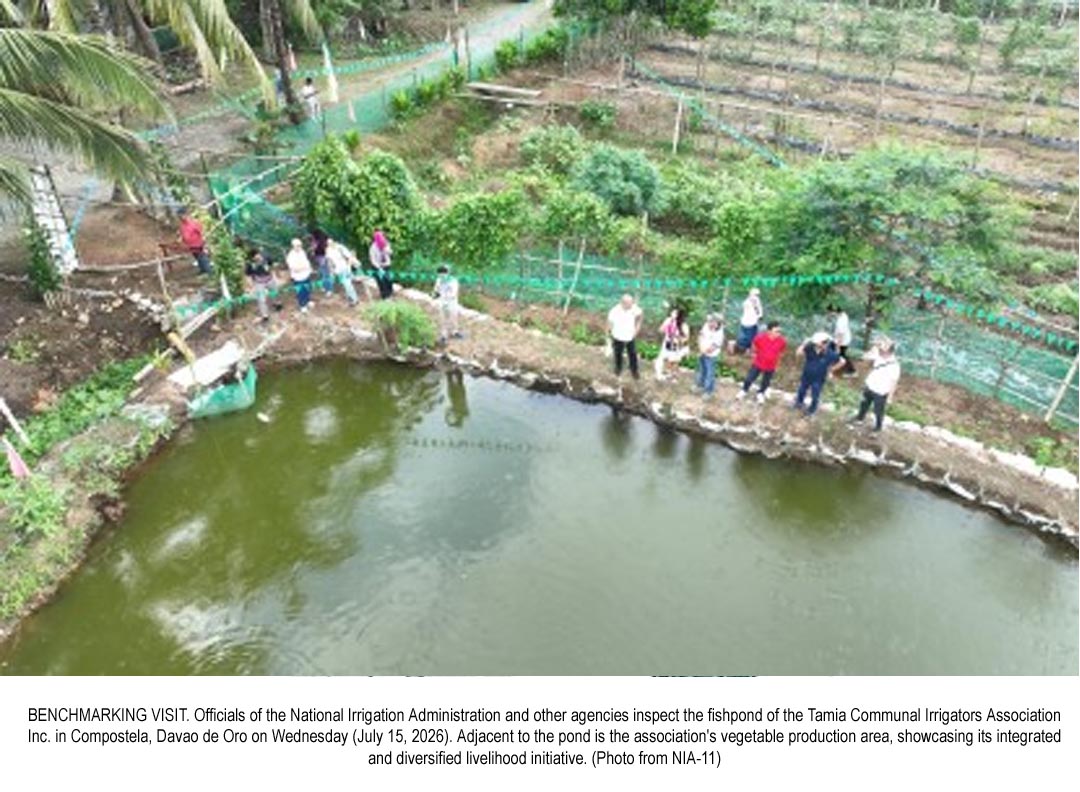
Tamia Communal Irrigators Association Inc. in Compostela, Davao de Oro.
Building Sustainable Farming Communities
NIA-11 Regional Manager Dexter Sablaon emphasized that the benchmarking activity is not merely an assessment of accomplishments but also an opportunity to strengthen the program through collaboration and innovation.
"This is more than a benchmarking activity—it marks the beginning of shared learning and the exchange of best practices that will further strengthen the implementation of Project LAWA at BINHI here in Davao Region and across the country," Sablaon said.
Government officials said the continued collaboration among national agencies and local farming communities is expected to further enhance agricultural productivity, improve rural incomes, and build climate-resilient farming systems that contribute to the country's long-term food security.
NPO News Team | PNA-PR