DA Tightens Protection of Prime Farmlands, Unveils Stronger Land Conversion Policy

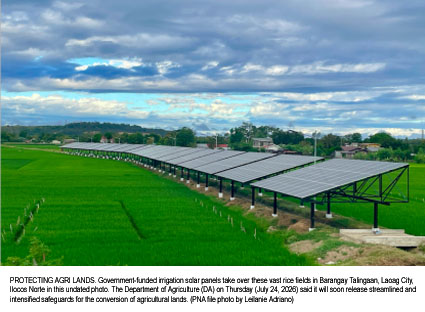
MANILA, Philippines – The Department of Agriculture (DA) is set to introduce a strengthened policy framework that will tighten safeguards on agricultural land conversion while streamlining approval procedures to ensure the long-term protection of the country's food-producing areas.
The policy initiative follows the lifting of the temporary moratorium on the issuance of Certifications on Land Use Reclassification under DA Memorandum Circular No. 32, Series of 2026, signed on June 30.
Speaking during the Economic Journalists Association of the Philippines (EJAP) Food Security Forum, Agriculture Secretary Francisco P. Tiu Laurel Jr. said the department is now finalizing the revised guidelines, which are expected to be released within the next one to two weeks.
A key feature of the new policy is the protection of at least 3 million hectares of rice-producing land, ensuring that the country's strategic agricultural areas remain dedicated to food production.
"The new policy will clearly identify the agricultural lands that must be protected. We need to maintain at least three million hectares of rice land," Secretary Tiu Laurel said.
According to the Agriculture chief, once these strategic agricultural zones are officially identified by the DA, they cannot be converted or altered unless authorized through a directive from the President of the Philippines.
The DA also emphasized the continued protection of irrigated agricultural lands, recognizing their critical role in sustaining national food security. Conversion of these areas will only be allowed when authorized by law or higher government authority.
Beyond irrigated lands, the department is also moving to safeguard highly productive agricultural flatlands, particularly areas with slopes below eight percent.
Secretary Tiu Laurel explained that while renewable energy investments such as solar farms are encouraged, projects without an agricultural production component should avoid occupying prime agricultural lands.
"If renewable energy projects like solar farms do not integrate agricultural production, we do not want them occupying our productive flatlands," he stressed.
The forthcoming policy also seeks to simplify and accelerate the land use reclassification process by reducing unnecessary administrative procedures while ensuring stricter environmental and agricultural safeguards remain in place.
Despite these reforms, local government land use plans and municipal zoning regulations will continue to serve as essential requirements before any application for agricultural land conversion can be approved by the Department of Agriculture.
The strengthened land conversion policy forms part of the government's broader strategy to balance infrastructure and economic development with the preservation of productive agricultural lands, reinforcing the country's commitment to food security, sustainable land management, and resilient agricultural growth.
NPO NEWS TEAM I PNA-PR