Marcos Administration Backs Bukidnon Coffee Farmers with ?50-M Development Fund

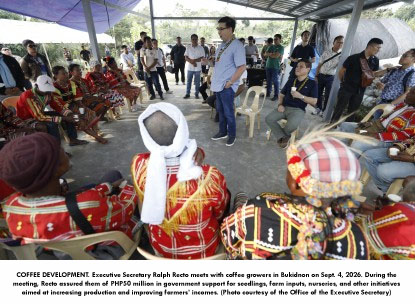
MANILA, Philippines — The national government has earmarked ₱50 million to strengthen and expand Bukidnon’s coffee industry, providing support to coffee farmers from seedling production to market development.
Executive Secretary Ralph Recto said the funding will be released through the Local Government Support Fund (LGSF) following discussions with local coffee growers and Indigenous farmers in Bukidnon.
According to Recto, President Ferdinand R. Marcos Jr. immediately responded to the needs raised by coffee farmers, directing concerned government agencies to provide comprehensive support that will help increase production, improve incomes, and expand market opportunities.
The ₱50-million assistance will finance specialty coffee seedlings, agricultural inputs, including parchment and chicken manure, and nursery development materials such as nets, plastic bags, hoses, and plastic drums.
The initiative forms part of the Marcos administration’s broader program to develop a stronger and globally competitive Philippine coffee industry. The government has also proposed ₱400.54 million for coffee development under the Department of Agriculture's 2027 National Expenditure Program.
Recto said government investments in seedlings, nurseries, farm inputs, infrastructure, and market access are expected to help reduce the country's dependence on imported coffee while increasing the competitiveness of locally produced coffee.
During his September 4 visit to Bukidnon, Recto, together with Senator Juan Miguel Zubiri and local government officials, met with coffee growers, including Indigenous farmers, at a municipal farm in Barangay Salawagan, Quezon.
He said Bukidnon has the land, climate, and agricultural workforce necessary to become one of the country's major coffee-producing areas.
Bukidnon is targeting a 200-percent increase in coffee production through the development of approximately 10,000 hectares of Arabica coffee farms. The province also aims to improve yields and establish a sustainable coffee value chain covering production, processing, manufacturing, and market distribution.
Within the next decade, Bukidnon is also targeting the export of high-quality specialty coffee through improved farming practices, expanded market access, and stronger production and processing systems.
The provincial government plans to establish additional coffee nurseries across its component local government units, including facilities in Barangay Kibenton in Impasugong and Barangay Bangcud in Malaybalay City.
Farmer cooperatives and associations in Talakag, Impasugong, Lantapan, Valencia City, and Pangantucan are also expected to receive support in establishing or upgrading coffee nurseries.
Recto said the national government will continue coordinating with Bukidnon's local governments to address infrastructure requirements, including farm-to-market roads, to improve the movement of agricultural products from farms to commercial markets.
Education Assistance for Bukidnon Students
Apart from agricultural development, Recto also highlighted government assistance for graduating college students in Bukidnon under the Presidential Scholars Program.
During his recent visit to Quezon town, Recto met with 155 scholars from the municipality's 31 barangays. Each barangay will have five graduating college students receiving financial assistance.
Across Bukidnon, approximately 2,320 graduating college students are expected to receive a total of ₱46.4 million, with each beneficiary receiving ₱20,000 to help cover tuition balances, transportation, learning materials, and other education-related expenses until graduation.
The program is part of a nationwide initiative expected to benefit more than 200,000 graduating students from approximately 42,000 villages across the Philippines.
Under the program, each village will receive ₱100,000, allowing five graduating college students to receive ₱20,000 each.
The Presidential Scholars Program complements the Marcos administration's broader education initiatives, including free tuition in state and local universities, expanded tertiary education subsidies, merit scholarships, technical-vocational training, and strengthened senior high school work-immersion programs.
The government has also introduced the Bagong Pilipinas Merit-Based Scholarship Program, targeting 20,000 scholars for School Year 2026–2027, as well as Project PEPA, which aims to connect around 490,000 senior high school graduates from Pantawid Pamilyang Pilipino Program households with government-supported tertiary education opportunities.
The combined agriculture and education programs underscore the government's continuing efforts to strengthen rural livelihoods, support farmers, and provide greater opportunities for Filipino students.
NPO NEWS TEAM
PNA-PR