Philippines Opens P237.9-M Buffalo Semen Facility to Advance Local Breeding

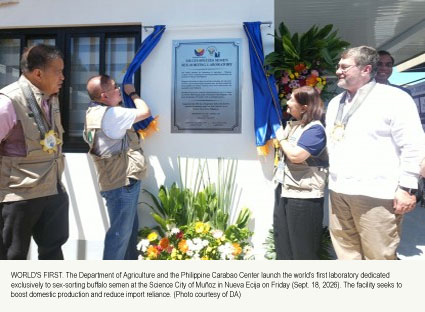
MANILA – The Philippines has inaugurated a PHP237.9-million laboratory in the Science City of Muñoz, Nueva Ecija, dedicated to sex-sorting buffalo semen, in a move aimed at strengthening local livestock breeding and reducing dependence on imported genetic materials.
The Department of Agriculture (DA) said Friday that the facility, established in partnership with the Philippine Carabao Center (PCC), is designed to increase the domestic production of genetically targeted buffalo breeding materials for dairy, meat and farm use.
DA Secretary Francisco Tiu Laurel Jr. said producing breeding materials locally could help reduce foreign exchange expenditures while creating additional income opportunities for farmers and supporting food security.
“Producing breeding materials locally saves foreign exchange, creates additional income opportunities for farmers and strengthens food security,” Tiu Laurel said.
The laboratory will use flow cytometry technology to separate sperm cells carrying female (X) and male (Y) chromosomes, with an expected sorting accuracy of about 90 percent.
The technology will allow breeders to select the sex of offspring based on production objectives. Female calves can be raised as future dairy animals, while male calves can be developed for meat production and farm work.
“This facility will give farmers the choice of whether they want a female calf that will eventually produce milk, or bulls for meat and farm work,” Tiu Laurel said.
After sorting, the semen will undergo cryogenic preservation before being distributed for artificial insemination programs across the country.
The DA said local production could help lower procurement costs and reduce the potential risks associated with the introduction of livestock diseases through imported breeding materials. It could also provide breeding stocks better suited to the country's tropical conditions.
Field distribution for artificial insemination is expected to begin in the fourth quarter of the year, with the first genetically targeted calves projected to be born by late 2027.
The PCC is targeting annual production of about 170,000 sex-sorted semen straws once the facility reaches its planned operational capacity.
The initiative comes as the Philippines continues to rely heavily on imported dairy products, with domestic production currently supplying less than 5 percent of the country's total dairy demand.
NPO NEWS TEAM | PNA-PR