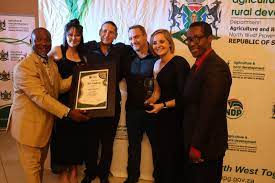
An elated farmer in Christiana in North West was unable to hide his excitement after receiving 45 goats, a handling facility and all the necessary add-ons to assist in developing the informal market further while alleviating poverty and contributing towards food security
There were sounds of joy in the agricultural town of Christiana on the banks of the Vaal River, when the North West department of agriculture and rural development (DARD) presented 45 goats to livestock farmer Solomon Lethoko from the Lekwa Teemane Local Municipality, marking a significant milestone under the weekly provincial Accelerated Service Delivery Programme, Thuntsha Lerole.
To boost goat production in the North West, the department has been using the massification programme focusing on the commercialisation of goats to alleviate poverty by selling meat, skins, crafts, and milk products.
A viable source of income
According to the department, goats are generally easy to care for animals because of their small size, adaptive feeding behaviour, and low management. It is therefore much easier for small farmers with no land or a small portion of land to farm with goats than with cattle, as 10 goats could be kept on the same portion of land as one cattle.
North West head of department Thupi Mokhatla explained that farmers must see their goats as a source of income to commercialise the goat industry. He added that the main advantage of goats is their resistance to diseases and adaptability to harsh grazing conditions.
“Goats are a practical choice in promoting the household cash flow of people in rural areas and can help resolve food insecurity for many households,” said Mokhatla.
The support to the farmer included 43 does and two bucks, a small-stock handling facility (still under construction), water provision, breeding stock, feeds, and medication.
Hopes for a better future
Elated recipient farmer Solomon Lethoko expressed his gratitude for his empowerment.
“The facilities will help reduce stress on the goats and aid in vaccinating, deworming, weighing, and the sorting process, which will give me an advantage when selling at auctions,” said Lethoko.
He highlighted that he has some experience with livestock production and he goes to auctions to buy goats and sheep to fatten and sell them back at different auctions. He indicated that he was also taking advantage of the informal trading.
“The majority of goats marketed in the province are sold by private transactions in the informal market to be slaughtered for religious or traditional purposes, therefore the informal market drives the goat industry,” he said.