Japan Grants P18.5M for Waste Management and Fisheries Projects in PH

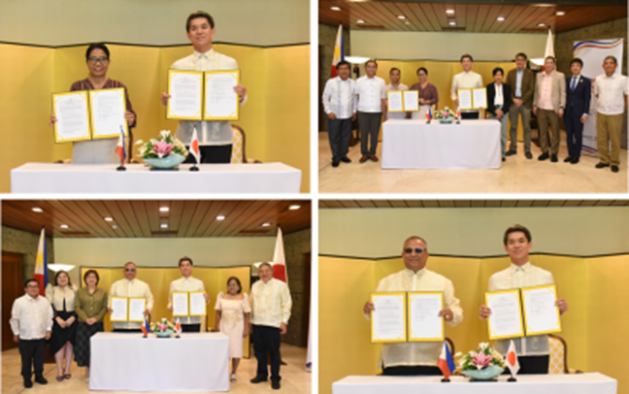
Japan Signs Grants to Support Waste Management in Bohol and Fisheries Development in Palawan
MANILA – The government of Japan has signed two grant agreements worth USD 318,098 (around PHP 18.5 million) to support community development projects in Bohol and Palawan.
The agreements were signed by Japanese Ambassador to the Philippines Endo Kazuya together with representatives from partner local government units and organizations during a ceremony held at the ambassador’s residence in Makati City on March 4, 2026. The grants were provided under the Grant Assistance for Grass-Roots Human Security Projects (GGP) program.
In his message, Ambassador Endo emphasized Japan’s strong partnership with the Philippines, highlighting the shared goals and mutual respect between the two countries. He also explained that the GGP program helps address the specific needs of local communities and supports initiatives that improve the lives of future generations.
One of the funded projects focuses on improving solid waste management in Ubay, Bohol. The project, valued at USD 243,055 (about PHP 14 million), will provide two new garbage compactors for the municipality.
Local officials shared that Ubay has been experiencing an increase in waste due to rapid population growth. However, waste collection has been limited because of outdated and insufficient equipment. Out of the town’s three garbage trucks, one is no longer operational, while the remaining two are already over ten years old. As a result, only about 10 percent of the municipality’s total waste is currently collected, mostly from areas near the town center.
With the addition of the new compactors, each capable of carrying 3.6 tons of waste, the municipality is expected to expand waste collection to more remote areas. This improvement will help provide better sanitation services to approximately 80,000 residents across 44 barangays.
The second project, worth USD 75,043 (around PHP 4.38 million), aims to improve fisheries facilities for an indigenous community in Taytay, Palawan. The grant was awarded to the UCCP-SLJA Integrated Development Program for Indigenous People in Southern Tagalog (IDLIP-ST), an organization that supports Indigenous Peoples through livelihood programs and capacity-building initiatives related to fishing, aquaculture, seaweed farming, and tourism services.
Due to the impact of natural disasters, the community’s Tribal House and Seaweed Farmhouse have deteriorated and are no longer usable, affecting the livelihood activities of local residents.
Through the project, a new Tribal Hall and Seaweed Farmhouse will be constructed. In addition, the community will receive two tricycles and four banca boats to help improve transportation and support their economic activities.
The GGP program, which started in the Philippines in 1989, focuses on supporting small-scale projects that directly benefit local communities and promote socio-economic development. With these newly signed agreements, Japan has now supported 569 grassroots projects in the Philippines under the program.
Japanese officials expressed hope that these initiatives will not only improve community livelihoods but also further strengthen the long-standing relationship between Japan and the Philippines.
Among those who attended the signing ceremony were Department of Agriculture Undersecretary Roger Navarro, Department of Environment and Natural Resources Assistant Secretary Jacqueline Caancan, Bureau of Fisheries and Aquatic Resources Mimaropa Regional Director Roberto Abrera, Palawan 1st District Representative Rosalie Salvame, Taytay Mayor Norbert Lim, and Palawan Council for Sustainable Development Executive Director Teodoro Jose Matta.
NPO NEWS TEAM I PNA - PR