DA and PSA Harness AI and Satellite Technology to Transform Agricultural Planning and Food Security

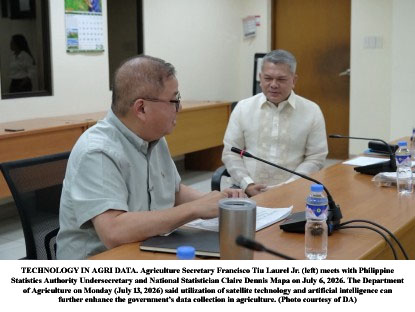
MANILA – The Department of Agriculture (DA) and the Philippine Statistics Authority (PSA) are strengthening their partnership by integrating satellite technology and artificial intelligence (AI) into agricultural data collection, a move aimed at improving food security planning and enhancing government decision-making.
The initiative supports the food security agenda of the Marcos administration by providing more accurate, timely, and technology-driven data that will guide agricultural production, logistics, resource allocation, and policy development.
Agriculture Secretary Francisco Tiu Laurel Jr. said reliable data is essential in ensuring that government interventions are directed where they are needed most.
"Accurate and timely data will ensure that our food security objectives are met. It tells us where production is strong, where it is weak, and where government intervention is needed," Tiu Laurel said.
He added that improved information systems will enable the government to allocate funding more efficiently while addressing emerging challenges in the agriculture sector.
A major component of the partnership is the expanded use of satellite imagery and AI to estimate crop production. The PSA has already piloted the technology, demonstrating its potential to generate faster and more accurate agricultural statistics.
PSA Undersecretary and National Statistician Claire Dennis Mapa said the initiative will become even more effective with the Department of Agriculture's extensive field network conducting on-site validation of satellite-generated information.
Ground verification, he explained, will ensure the accuracy and reliability of remotely collected agricultural data, allowing policymakers to make better-informed decisions.
Mapa emphasized that agriculture and fisheries remain critical drivers of economic growth, employment, and national food security, making accurate statistics an indispensable component of government planning.
"We want to assure the DA that we are generating reliable and accurate statistics. The accuracy of data is critical in supporting sound policymaking," Mapa said.
Beyond measuring current production, Tiu Laurel said the enhanced data system will help government agencies anticipate future trends and respond proactively to potential food supply challenges.
"Data should not simply tell us what happened. It should help us anticipate what comes next so the DA can be proactive, not reactive, in protecting the country's food supply," he said.
The collaboration also coincides with the PSA's rollout of the 2026 National Census, the country's first nationwide population census in nearly a decade. The updated demographic and consumption data will provide the DA with a more accurate basis for estimating national food requirements, refining production targets, and developing more responsive investment and funding strategies for the agriculture sector.
The partnership between the DA and PSA reflects the government's continuing push toward digital transformation, leveraging artificial intelligence, satellite technology, and data analytics to modernize Philippine agriculture, strengthen food security, and support evidence-based policymaking.
NPO NEWS TEAM | PNA-PR