Smart Warehouses Power NFA Push to Safeguard Rice Supply

The National Food Authority (NFA) is modernizing its storage facilities to better protect the country’s rice reserves and reduce post-harvest losses.
In Pili, Camarines Sur, the agency has begun upgrading a key warehouse complex with new technology designed to improve storage conditions for palay and strengthen the country’s rice buffer stock system. Officials say the project will also help safeguard the income of Filipino rice farmers by preserving grain quality after procurement.
At the center of the upgrade is an automated ventilation system built to maintain stable temperature and humidity levels inside the warehouse. Microcomputer control units equipped with processors and LoRa connectivity gather temperature and humidity readings every five minutes from wireless sensors placed in heat-prone areas.
Once the hourly average temperature reaches a set threshold, industrial exhaust blowers activate automatically. Each unit can move up to 10,000 cubic meters of air per hour—enough to remove accumulated heat from a space comparable to two full-sized school gymnasiums within an hour. Because the system operates automatically, it eliminates the need for manual switching and ensures continuous, data-driven airflow management.
The ventilation system for the Camarines Sur facility carries an estimated cost of P1.21 million.
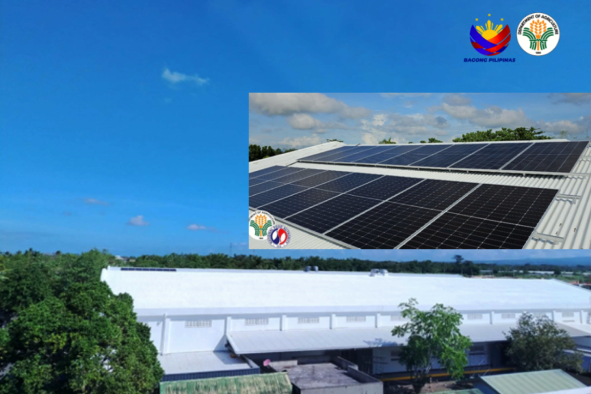
Supporting the upgrade is a 16-kilowatt solar power system composed of 32 high-capacity panels, a three-phase hybrid inverter, and five 15-kilowatt-hour batteries. At peak operation, the warehouse consumes about 12 kilowatts, or roughly 75 percent of the system’s rated capacity—enough to power exhaust motors, lighting, office equipment, and air-conditioning units.
The solar installation represents an additional P1.40 million investment, part of the NFA’s push to improve energy resilience while lowering operating costs.
To further protect stored grain, thermal insulation is also being considered for the warehouse roof. Insulation materials are rated using R-values, which measure resistance to heat transfer and help limit the amount of heat entering the facility from above.
For a duplex warehouse with a 200,000-cavan design capacity and a floor area roughly equal to nine standard basketball courts, maintaining stable temperatures is essential to prevent moisture buildup and maintain grain quality.
Estimated insulation costs range from P3.26 million to P3.70 million.
NFA Administrator Larry Lacson said the modernization effort is ultimately aimed at protecting farmers’ harvests.
“This upgrade is about protecting the hard work of our rice farmers,” Lacson said. “By improving storage conditions, we reduce post-harvest losses, preserve grain quality, and make sure the palay we procure retains its value. That strengthens confidence in the system and ensures farmers are properly supported.”
Agriculture Secretary Francisco P. Tiu Laurel Jr., who chairs the NFA Council, said the project reflects broader efforts to modernize Philippine agriculture.
“This modernization effort reflects our commitment to transform Philippine agriculture,” Tiu Laurel said. “By investing in better storage, renewable energy, and smarter systems, we are improving farmers’ incomes, reducing waste, and reinforcing food security for every Filipino family.”
The NFA’s Camarines Sur branch is also working with Central Bicol State University of Agriculture to further validate and refine the system’s performance.
As climate pressures intensify and supply chains become more fragile, officials say the message from Pili is clear: food security depends not only on harvests in the field, but also on how well those harvests are protected in storage.
NPO News Team | DA Press Office - PR