Philippines promotes agriculture as a viable investment sector at ADB forum

The Philippines is strengthening its campaign to attract global investors to its agriculture sector, emphasizing that farming and fisheries should be viewed not just as development concerns but as profitable and bankable investment opportunities.
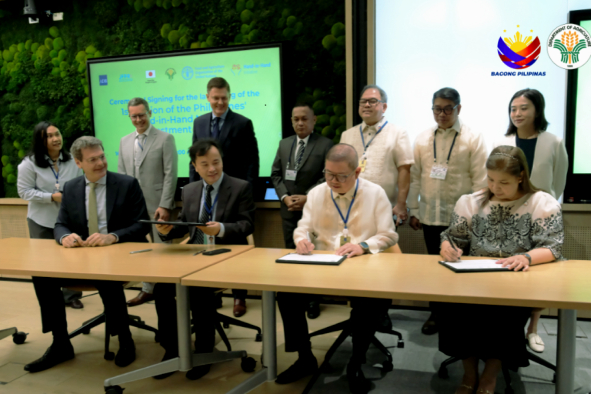
During the ceremonial signing of the partnership for the Hand-in-Hand National Investment Forum 2026 at the Asian Development Bank, Agriculture Secretary Francisco P. Tiu Laurel Jr. highlighted a new approach in presenting the country’s agri-fisheries sector to international investors.
The forum, organized in collaboration with the Food and Agriculture Organization (FAO), aims to attract private investments into agriculture, fisheries, and rural infrastructure. These areas are considered to have strong growth potential but have long suffered from limited financing.
“Today, we formalize our shared vision for the agri-fisheries sector,” Tiu Laurel said, noting that the initiative brings together development institutions and private investors to help accelerate rural development.
At the center of the initiative is the Hand-in-Hand (HIH) program, a global FAO platform that connects data-driven agricultural priorities with financing and technical support. Hosting the National Investment Forum in the Philippines reflects the country’s efforts to convert international interest into actual investments.
The initiative also supports the economic agenda of Ferdinand Marcos Jr., whose administration has prioritized revitalizing agriculture to strengthen food security and raise rural incomes.
According to Tiu Laurel, the Philippines’ participation in the FAO Global Hand-in-Hand Investment Forum in 2024 and 2025 showed that the country’s agricultural sector can attract global financiers. Holding the forum in Manila, he added, is meant to help “bridge the gap between global capital and local stakeholders.”
That gap has long limited the sector’s growth.
Although agriculture employs millions of Filipinos, it has historically struggled to secure large-scale investments due to fragmented supply chains, climate risks, and infrastructure challenges.
By positioning agriculture as a “highly bankable sector,” the Department of Agriculture is signaling a stronger push for investment-driven modernization.
The National Investment Forum will highlight high-impact projects in key commodities, including farm production, food processing, logistics, and value-chain development—areas where development banks and private investors increasingly see business opportunities.
Officials also stressed that transforming rural economies will require more than public funding. While institutions like ADB and FAO can provide expertise and support frameworks, the expansion of agricultural ventures will largely depend on private capital.
Tiu Laurel said the goal of the forum goes beyond attracting funding.
“Through this forum, we redefine Philippine agriculture from being a legacy of the past to a sustainable engine for growth,” he said.
The success of the initiative, however, will depend on investor interest and whether farmers and fishers ultimately benefit from the investments directed toward the countryside.
NPO News Team | DA Press Office - PR