Philippine unemployment rate drops to 5.1% in February — PSA

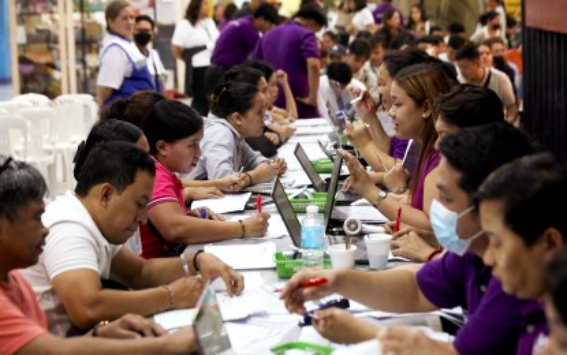
MANILA – The number of unemployed Filipinos declined in February, signaling improving labor market conditions, according to the Philippine Statistics Authority (PSA).
Data from the latest Labor Force Survey showed that unemployment fell to 2.66 million in February 2026, down from 2.96 million in January. This brought the unemployment rate to 5.1 percent, an improvement from the previous month’s 5.8 percent.
National Statistician Dennis Mapa said the Labor Force Participation Rate (LFPR) also rose to 63.8 percent, higher than January’s 62.3 percent. This translates to about 52.09 million Filipinos aged 15 and above who are either employed or actively seeking work.
The employment rate reached 94.9 percent in February, with the total number of employed individuals increasing to 49.43 million from 47.94 million in January.
Meanwhile, underemployment — referring to workers seeking additional hours or better-paying jobs — was recorded at 5.84 million, equivalent to an 11.8 percent rate.
In a statement, the Department of Economy, Planning, and Development (DEPDev) said the government is intensifying efforts to safeguard jobs amid uncertainties caused by geopolitical tensions in the Middle East.
DEPDev Secretary Arsenio Balisacan warned that ongoing conflicts could continue to disrupt both global and domestic labor markets.
“Recent developments highlight the urgency of strengthening labor market resilience and ensuring that policies can respond effectively to rapidly changing global conditions, especially for affected Filipino workers,” he said.
To address these risks, the government is rolling out measures under the Unified Package for Livelihoods, Industry, Food, and Transport (UPLIFT) Committee, created through Executive Order 110. These initiatives aim to maintain essential services, support incomes, and sustain economic activity despite rising fuel costs.
Among the interventions are cash assistance programs, fuel subsidies for vulnerable sectors, and the expansion of employment initiatives.
The Department of Agriculture is deploying its PHP1-billion quick response fund to support fuel subsidies and biofertilizer procurement, while transport and farm workers can access emergency employment through government programs.
These include the Service Contracting Program of the Department of Transportation and the Tulong Panghanapbuhay sa Ating Disadvantaged/Displaced Workers program of the Department of Labor and Employment.
Looking ahead, the government is also promoting renewable energy and electric vehicle development as part of long-term economic resilience. Skills training programs will be expanded to help workers transition into emerging industries tied to cleaner energy.
Balisacan said these efforts aim to prepare the workforce for shifts in energy use and ensure continued employment opportunities amid global economic changes.
NPO News Team | Philippine News Agency - PR