PRIT Group Launches Community-Based "PRIT Grass Cooling Hypothesis" to Help Reduce Local Heat During Super El Niño

Community-Led Green Landscapes Proposed as a Nature-Based Climate Adaptation Strategy
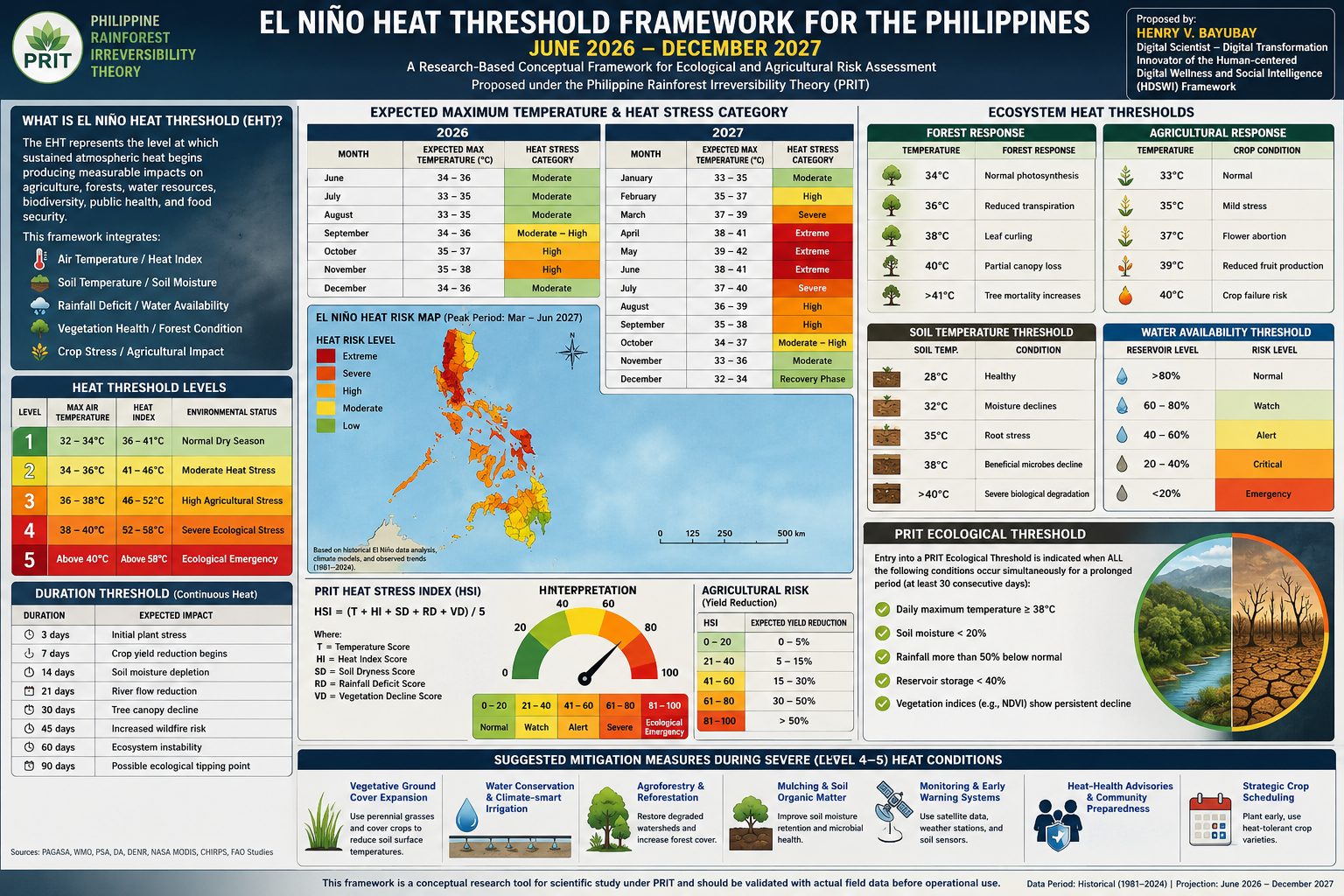
Bacolor, Pampanga, Philippines — August 2, 2026 — As the Philippines continues to face the increasing risks of extreme heat associated with Super El Niño, the Philippine Rainforest Irreversibility Theory (PRIT) Group has introduced the PRIT Grass Cooling Hypothesis (PGCH)—a proposed scientific hypothesis that encourages communities to expand perennial grass cover around homes, schools, public spaces, and urban landscapes as a practical, low-cost climate adaptation measure.
The PRIT Grass Cooling Hypothesis (PGCH) is part of the broader Philippine Rainforest Irreversibility Theory (PRIT) research initiative and was introduced by Henry V. Bayubay, Lead Developer of PRIT, as a proposed nature-based climate adaptation program aimed at encouraging scientific research and community participation in addressing the impacts of extreme heat.
Bayubay is recognized by colleagues and partner organizations for his work in digital transformation, environmental innovation, and community-centered technology development, and is regarded by many as a Digital Scientist and Digital Transformation Advocate. He is also the innovator behind the Human-Centered Digital Wellness and Social Intelligence (HDSWI) Framework, an interdisciplinary framework promoting the ethical, responsible, and human-centered use of digital technologies and artificial intelligence. In addition, he serves as the Vice President of the Filipino Inventors Society Multipurpose Cooperative (FISMPC), where he supports programs that foster Filipino innovation, research, and technology commercialization.
The hypothesis proposes that dense perennial grass vegetation may help reduce localized surface and near-ground air temperatures through natural ecological processes, including evapotranspiration, soil shading, improved soil moisture retention, and increased atmospheric humidity. The PRIT Group emphasizes that the hypothesis is intended to be tested through field experiments, independent scientific validation, and peer-reviewed research before broader conclusions are drawn.
A Community-Based Response to Extreme Heat
According to the PRIT Group, rising temperatures during prolonged El Niño events are intensified by extensive areas of exposed concrete, asphalt, rooftops, and bare soil that absorb and re-radiate heat throughout the day. Replacing portions of these exposed surfaces with healthy vegetation could contribute to cooler neighborhood environments while providing additional ecological benefits.
The proposed hypothesis states:
"The establishment of dense perennial grass cover around residential, institutional, and urban landscapes reduces local surface temperature and ambient air temperature during El Niño events through the combined effects of evapotranspiration, soil shading, increased soil moisture retention, and improved atmospheric humidity."
While this statement reflects the proposed hypothesis, the PRIT Group notes that its effectiveness and the magnitude of its cooling benefits should be verified through carefully designed scientific studies conducted under different environmental conditions.
To support this effort, the PRIT Group has initiated a pilot residential field experiment in David Avenida, Xevera Subdivision, and their Laboratory, Dona Lucing Subd. at Calibutbut, Bacolor, Pampanga, where researchers will monitor ambient temperature, surface temperature, soil moisture, humidity, and thermal comfort over a twelve-month period. The study aims to generate baseline scientific data that can contribute to future research on nature-based climate adaptation strategies.
The PRIT Group invites universities, environmental scientists, climatologists, ecologists, engineers, local government units, and research institutions to collaborate in independently evaluating the PRIT Grass Cooling Hypothesis through transparent, evidence-based scientific investigation.
As climate change continues to intensify heat extremes across the Philippines, the organization hopes the initiative will encourage communities to participate in practical environmental solutions while contributing valuable scientific knowledge on sustainable, low-cost approaches to improving local climate resilience.
Media Contact
PRIT Group
Philippine Rainforest Irreversibility Theory (PRIT) Research Initiative
Program Introduced by: Henry V. Bayubay
Lead Developer, Philippine Rainforest Irreversibility Theory (PRIT)
Innovator, Human-Centered Digital Wellness and Social Intelligence (HDSWI) Framework
Vice President, Filipino Inventors Society Multipurpose Cooperative (FISMPC)
Philippines