Hamada Boiler and FLDC Explore Circular Economy Integration for Greenhouse Paradise Country Farm in San Jose, Tarlac

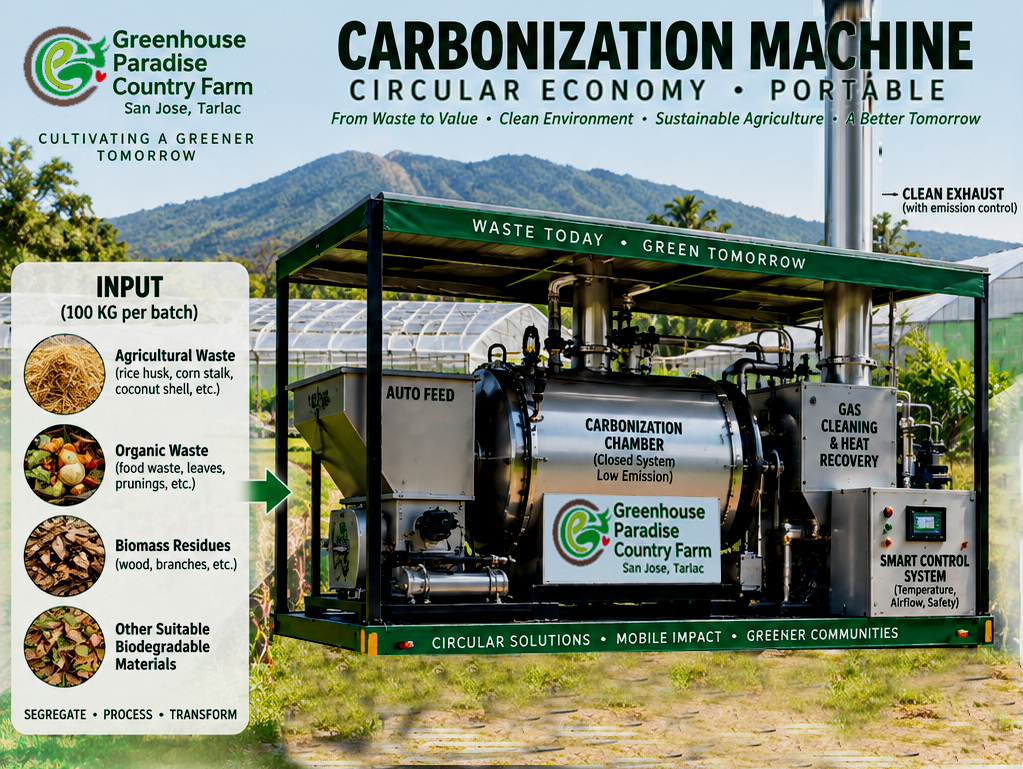
Proposed Carbonization System to Transform Waste Management into a Resource for a Future Sustainable Agri-Green Community
BONIFACIO
GLOBAL CITY, TAGUIG CITY — September 15, 2026 — Hamada Boiler (HB) and Filipino Land Development
Corporation (FLDC) have initiated discussions on the potential integration of
an advanced carbonization-based waste management system into the
development of Greenhouse Paradise Country Farm (GPCF) in San Jose,
Tarlac.
The
exploratory meeting, held in Bonifacio Global City, brought together
representatives of Hamada Boiler, FLDC, and Country First Realty Development
Corporation to discuss how waste processing technology could be incorporated
into the planned development of GPCF and contribute to the project's broader
circular-economy vision.
The
discussions focused on the proposed deployment of an initial carbonization
machine capable of processing municipal and other suitable waste materials,
with the objective of reducing waste going to disposal facilities while
converting selected waste streams into useful by-products and potentially
recoverable energy resources.
According
to Kojiro Hamada, Director for Asia Operations of Hamada Boiler, the
initiative presents an opportunity to demonstrate how appropriate
waste-to-resource technologies can contribute to addressing the Philippines'
growing solid-waste management challenges.
“We
believe that this project can contribute to the Philippines' continuing efforts
to address the garbage problem by demonstrating a more sustainable approach to
waste management,” Hamada said.
For FLDC
President Henry V. Bayubay, the proposed partnership is significant
because environmental sustainability is embedded in the development philosophy
of Greenhouse Paradise Country Farm.
“This
partnership matters to us because one of the principal objectives of Greenhouse
Paradise Country Farm is not simply to develop land, but to develop a community
where environmental protection, agriculture, technology and economic
development work together,” Bayubay said.
Bayubay
emphasized that the carbonization initiative is being explored as part of a
larger circular economy framework, in which waste generated by the
community can potentially become an input for another productive process rather
than being treated solely as a disposal problem.
Mr.
Takahiro Kawashima,
Environmental Consultant of Biorganism Corporation and a member of the
FLDC sustainable engineering team, also emphasized the strategic importance of
bringing Hamada Boiler into the project's sustainability planning.
According
to Kawashima, the participation of Hamada Boiler could provide an important
technological component in realizing the long-term environmental objectives of
Greenhouse Paradise Country Farm.
“Bringing
Hamada Boiler into the group can help us further realize the sustainability
vision of Greenhouse Paradise Country Farm in the long run. Waste management,
resource recovery and energy integration are important elements if we want to
establish a truly sustainable community,” Kawashima said.
He noted
that sustainability should be considered from the earliest stages of
development rather than introduced only after a community has been established.
By integrating appropriate environmental technologies into the project's master
planning, GPCF can potentially establish a more efficient system for managing
resources, reducing waste and supporting agricultural production.
Kawashima
further emphasized that the proposed carbonization system should be evaluated
as part of an integrated environmental and engineering framework, connecting waste
management, resource recovery, agriculture, energy and community development.
The FLDC
sustainable engineering team sees the exploratory partnership with Hamada
Boiler as an opportunity to strengthen the technical foundation of GPCF and
potentially establish the project as a demonstration model for future circular-economy
and sustainable community developments in the Philippines.
Building a Circular Agri-Green Community
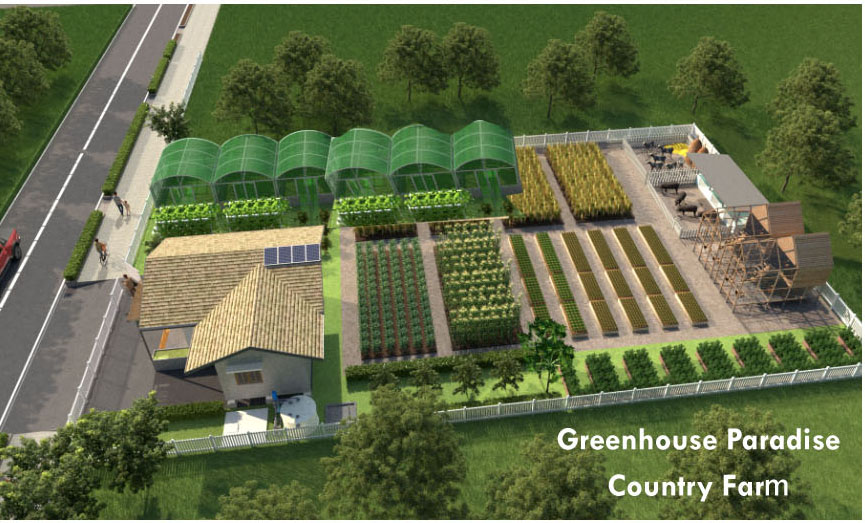
Greenhouse
Paradise Country Farm is envisioned as a large-scale agri-green and
farm-tourism development in San Jose, Tarlac, integrating modern
agriculture, greenhouse production, residential and hospitality components,
environmental management and technology.
The
development concept is designed to demonstrate how a modern agricultural
community can incorporate sustainability into its basic infrastructure and
daily operations.
Under the
emerging circular-economy concept, waste management would not operate as an
isolated facility. Instead, it would potentially be integrated with the
project's agricultural, energy, water, logistics and environmental systems.
The
proposed carbonization system is therefore being studied as one component of a
broader ecosystem that could include:
- Waste segregation and
resource recovery
- Carbonization of appropriate
waste materials
- Conversion of waste into
useful carbonized by-products
- Potential thermal and
steam-energy recovery
- Agricultural applications of
appropriate recovered materials
- Greenhouse and farm
integration
- Reduction of waste
transported to conventional disposal facilities
- Environmental monitoring and
digital management
- Circular-resource
utilization within the development
The
partners stressed that the project remains subject to technical,
environmental, engineering, regulatory and economic assessments before any
final implementation decision is made.
Country First Realty Development Corporation
Supports Sustainable Development Approach
Also
participating in the exploratory discussions was Gerard Sigua, Owner of
Country First Realty Development Corporation, the exclusive development
partner for the Greenhouse Paradise Country Farm project in Tarlac.
Sigua
expressed support for incorporating a sustainable waste-management system into
the development, emphasizing the importance of integrating environmental
considerations into the project's long-term planning.
The
participation of Country First Realty Development Corporation reinforces the
intention to evaluate waste management not merely as an operational requirement
but as an integral component of the future community's development
infrastructure.
From Farm Development to a Model Sustainable
Community
The
proposed integration of carbonization technology forms part of FLDC's broader
vision of developing GPCF as a potential model for sustainable agricultural
communities in the Philippines.
The
project seeks to demonstrate how agriculture, green infrastructure, renewable
and alternative energy technologies, waste management, digital systems and
community development can be planned as interconnected components.
Rather
than following a traditional linear model of:
Resources
→ Production → Consumption → Waste → Disposal,
the
project is exploring a circular model:
Resources
→ Production → Consumption → Recovery → Processing → Reuse → Agriculture/Energy
→ Community.
This
approach is intended to reduce environmental pressure while creating additional
opportunities for resource recovery and economic activity.
Bayubay
said the objective is aligned with the broader United Nations Sustainable
Development Goals (SDGs), particularly those relating to sustainable
communities, responsible consumption and production, climate action, clean
energy, environmental protection and sustainable economic development.
“Our
objective is to create a development where sustainability is not an added
feature but becomes part of the operating system of the community,” Bayubay
explained.
A Potential Demonstration Site for Future
Developments
The
proposed carbonization system could eventually serve as a demonstration of how
waste-to-resource technologies may be incorporated into large-scale
agricultural and community developments.
If
technically and commercially viable, the concept could potentially provide a
framework that may be adapted to other agricultural estates, farm-tourism
developments, municipalities, economic zones and emerging smart communities.
The
initial meeting therefore represents the beginning of a technical and
development-planning process between the parties rather than the final
implementation of the system.
The next
stages are expected to focus on technical validation, waste-stream
assessment, site planning, environmental and regulatory compliance, energy
integration, economic feasibility and system design.
For FLDC
and its development partners, the long-term goal remains clear: to explore a
new generation of Philippine communities where agriculture, environmental
protection, technology and economic development are designed to operate
together.
About Greenhouse Paradise Country Farm
Greenhouse
Paradise Country Farm (GPCF) is a planned agri-green and farm-tourism
development in San Jose, Tarlac, envisioned to integrate modern
greenhouse agriculture, hospitality, residential components, environmental
infrastructure and smart technologies.
The
project is being developed around the concept of creating a sustainable
community where agricultural productivity, ecological responsibility and modern
living can coexist.
About Filipino Land Development Corporation
Filipino
Land Development Corporation (FLDC) is a Philippine development company focused on
land development, architectural and design services, sustainable communities
and technology-enabled development systems.
FLDC
promotes development approaches that integrate environmental sustainability,
agriculture, digital technology and community-oriented economic development.
About Hamada Boiler
Hamada
Boiler is an
Asian boiler and biomass-energy technology company engaged in the development
of biomass combustion and related energy systems.
The
company has expressed interest in exploring technologies that can contribute to
more sustainable energy and waste-management solutions in the Philippines.
NPO News Team I
Biorganism-FLDC-PR