Immediate Action Urged as Sugar Industry Battles Worsening Red-Striped Soft Scale Insect Infestation

BACOLOD CITY, Philippines – With only three months remaining before the sugarcane harvest season, the Sugar Regulatory Administration (SRA) has intensified its response to the growing infestation of the red-striped soft scale insect (RSSI), committing immediate technical assistance to local government units (LGUs) and farmers across Negros Island.
SRA Administrator Pablo Luis Azcona said the agency is prioritizing rapid intervention measures, particularly for LGUs that have sought direct assistance in protecting their standing sugarcane crops from the rapidly spreading pest.
"As part of our commitment to the mayors who have approached us, we will immediately provide the assistance they require to help minimize the impact of this infestation," Azcona said.
The SRA is expected to begin deployment efforts in affected areas of Negros Oriental, where local officials and farmers have expressed readiness to implement immediate control measures.
More Than 200,000 Hectares Affected
Current reports indicate that approximately 30 percent infestation has already spread across more than 200,000 hectares of sugarcane plantations throughout Negros Island, posing a serious threat to the country's sugar industry.
According to SRA studies, severe RSSI infestation can reduce the sugar content of infected sugarcane by as much as 50 percent, significantly affecting both crop yield and sugar recovery.
Balancing Immediate Response and Sustainable Solutions
While welcoming the Negros Occidental provincial government's initiative to adopt environmentally friendly pest management strategies, Azcona emphasized that the SRA has long supported biological and natural control methods as part of its long-term pest management program.
He revealed that Agriculture Secretary Francisco Tiu Laurel Jr. has instructed laboratories under the Department of Agriculture to accelerate the production of beneficial fungi that can naturally suppress RSSI populations.
"We have already initiated this green approach since last year," Azcona explained. "However, biological control is a long-term solution. It takes time and requires substantial investment before results become evident."
Immediate Chemical Intervention Still Necessary
Despite the agency's commitment to sustainable agriculture, Azcona stressed that immediate intervention remains critical to prevent severe crop losses before harvest.
Drawing from his own experience, he noted that bio-pesticides can cost four to five times more than conventional insecticides while producing slower results—an approach many farmers cannot presently afford.
"What our sugar industry needs today is an urgent response. With harvest only three months away, delaying action could result in significant production losses," he said.
Drone Technology Deployed to Protect Farms
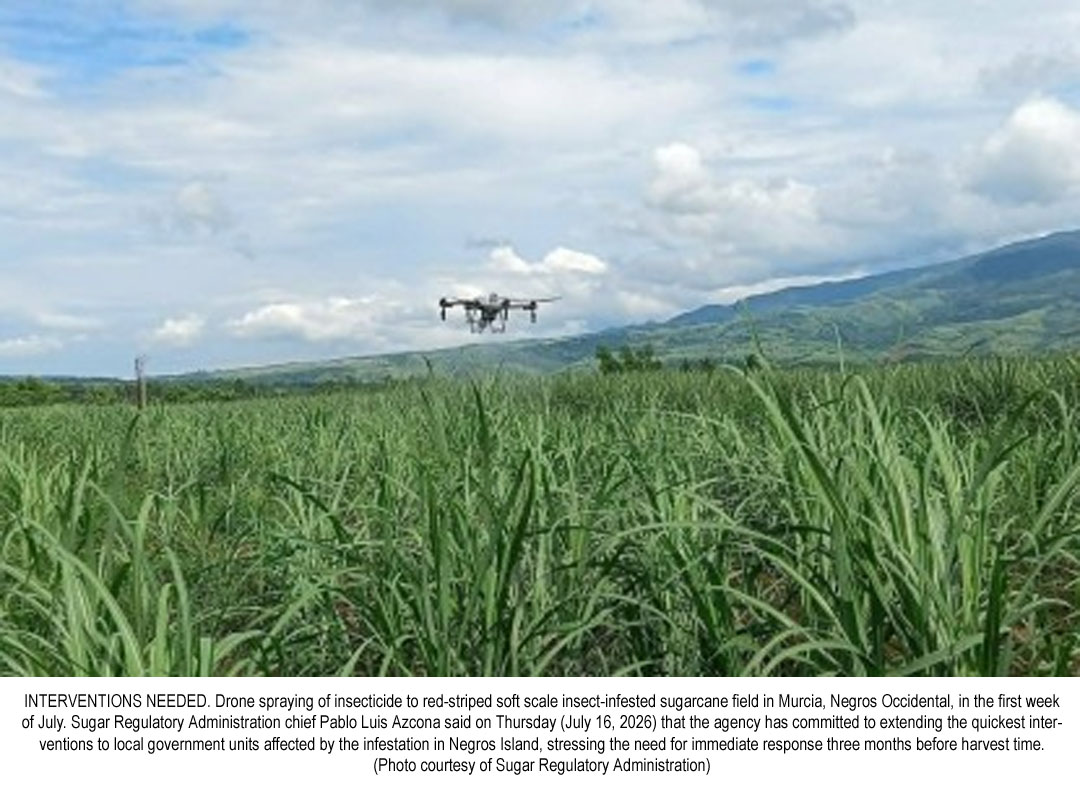
To strengthen field operations, the SRA has expanded the use of agricultural drones for precision spraying of affected plantations.
Azcona reported that farms which invested in drone-assisted low-and-slow spraying techniques during last year's outbreak successfully reduced infestation levels.
The SRA has likewise acquired its own fleet of spraying drones and continues to provide aerial treatment services upon request from farmers needing immediate assistance.
Potential National Production Losses
The agency estimates that the current infestation level already affects roughly 67,000 hectares of sugarcane farms in Negros Occidental alone.
Based on last year's experience in northern Negros, affected farmers suffered production losses ranging from 40 to 50 percent in both cane tonnage and sugar recovery.
Without swift intervention, SRA projects that approximately 33,000 hectares of sugarcane production in Negros Occidental could be lost, resulting in an estimated 150,000 metric tons of raw sugar—equivalent to nearly eight percent of the country's total annual sugar production.
Unified Action Among Local Governments
Meanwhile, Cadiz City Mayor Salvador Escalante, President of the Association of Chief Executives in Negros Occidental, announced that all available control measures will be presented during a meeting of provincial mayors.
Escalante emphasized that systemic chemical treatments remain among the available options and underscored the importance of a unified provincial response.
"We need to act together to protect our standing crops and safeguard the livelihood of thousands of sugar farmers," he said.
As the harvest season approaches, government agencies, local officials, and industry stakeholders continue to work together to contain the RSSI outbreak and protect one of the country's most important agricultural industries.
NPO News Team I PNA-PR